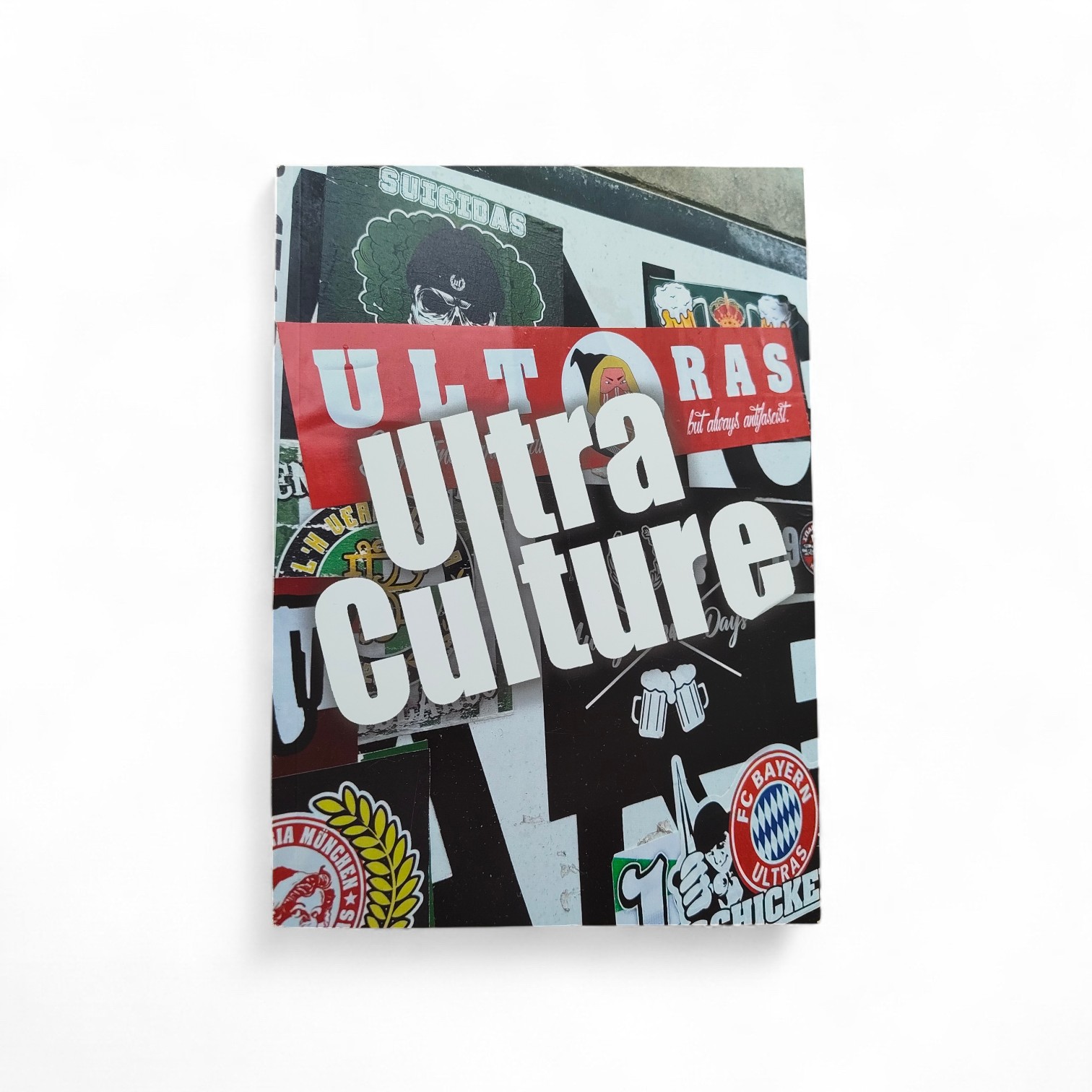
Ultra Culture is an A3-sized magazine that I got online somewhere a few months ago. However, when it arrived, I put it aside and forgot all about… Picking it up again, I can’t actually remember where it was from or even who might’ve produced it! Whoever it is, they obviously get around a decent amount and, as the mini blurb on the back cover boasts, has clocked up over 600 stickers from teams all over Europe. I’m obviously talking about football clubs here and, yes, this is a mag dedicated to their fans’ stickers.
Stickers have long been an element of football fan culture in the UK. However, in the recent past they weren’t too common and seemed to be either associated with specific hooligan groups or else had a political angle. Some of these style of stickers make an appearance in Ultra Culture such as Real Sociedad’s RSF Firm, or Millwall’s Berserkers. The mag starts by introducing stickers as a growing phenomenon, and one with a DIY element. Not found in official shops and out of the control of corporate sanitisation, leaves room for political sentiments to creep in. The first few stickers featured include anti-Glazer and anti-Tory examples from Man U fans, with more sprinkled throughout the rest of the magazine.
For European fans, stickers have been a much more prominent way of showing support for clubs, and they go hand-in-hand with graffiti, marking out where loyalties lie in areas of the city. On my own travels I’ve always been particularly impressed with fans’ dedication to their stickers in Germany, Poland and the Balkans. The ultras style is dominant in football on the continent which is also reflected in the stickers. An example of one of these is the ‘Tough Guys 1992’ sticker on a lamppost featuring the cartoon character Wile E. Coyote. It’s not obvious this has anything to do with football at all, but it’s actually from a group of ultras from some Austrian team. References to cartoons seem quite popular on the continent. Andy Capp is an ever present favourite reflecting the game’s working-class base, but other characters also pop up in Ultra Culture including Stewie Griffin, one of the Beagle Boys, and the more obscure Bullseye Billy.
I love it when you spot competing fans staking a claim over one another
Other genres of sticker include declarations of friendships between clubs (a bit of an alien thing in English football), rivalries, and local loyalties. I love it when you spot competing fans staking a claim over one another, and Ultra Culture does too, including examples of Arsenal over Chelsea and, in turn, Chelsea over Tottenham. Then there’s the regional fan clubs, such as Sporting’s Casal de Cambra, and ‘on tour’ stickers, which might end up on a copper’s back during a Champions League game, or else get stuck up in some far-flung holiday destination. Other stickers in the magazine tie a club to local identities, such as the Pro League sticker declaring “proud to be farmers”, although I’m not clued up enough with Belgian football to know if this one was actually produced by rival fans taking the piss.
This magazine’s a few years old now, meaning current trends are missing. The recent use of the St George, England’s national flag, on bridges and roundabouts across the country by the far-right can be found in football culture too. Sticker designs showing the England flag covered with anti-immigrant statements or using racist symbols have become quite popular. Last year the folk singer Jennifer Reid, posted up a couple of reels in response the flag-shagging phenomenon on her Instagram. When it comes to football, I think the St George has fulfilled a kind of folk role for many fans. The team’s name or an area where a group of supporters are from is written across the flag, with the four white corners used for symbols related to the club including the badge and whatever else. I used to work in a factory where the machinists made one of these flags for the foreman to take to away games. The flag shows loyalty to a local club, but they are also displayed at England games, where they blend into this impressive mass of fabric. Until recently, the St George wasn’t so toxic, at least in comparison to the Union Jack, and football fans who used it weren’t necessarily doing so to be racist.
There has also been a backlash against this with anti-racist fans making their own versions of the St George. These are often based on the 2024 redesign of the England kit by Nike, which caused outrage with the right-wing press and was criticised by the British Prime Minister Keir Starmer. The use of Nike’s ‘woke’ England flag on the stickers of left-wing fans works as both a rejection of racism and, being something of a hate figure for the left, the spinless lib politics Starmer represents.
The magazine does have some texts introducing different sections. One of these mentions what “seems to be a UK trend” of referencing musical artists such as the Stone Roses. This particular type of design seems to be going out of fashion now, with football stickers increasingly incorporating ironic and humorous elements, particularly those from left-leaning fans. While there are a few of these type in Ultra Culture, the continued evolution of football stickers shows that this form of street art is an increasingly important part of fan culture.